From Long-haul to Smart haul: INR fall reshapes Indian travel trends
 (L-R) Mahendra Vakharia; Neil Patil; Shiv Kukreja
The fall of the Indian Rupee (INR) past the INR 95 mark against the US dollar is not just a currency story, it is a turning point for India’s tourism sector as well. One of the sharpest declines in over a decade, it is already changing how Indians plan, spend, and travel.
While the rupee has seen a slight recovery to around 93.19 following intervention by the Reserve Bank of India, the larger impact is being felt on the ground. International travel has become 10 – 15% more expensive, forcing travellers to rethink plans. Long-haul trips are being reconsidered, and budgets are coming under pressure.
At the same time, this weakness is creating a strong opportunity for inbound tourism. A softer INR makes India more affordable for foreign travellers, improving the country’s competitiveness and boosting foreign exchange potential, amid the geopolitical uncertainty.
What is emerging is not a slowdown, but a clear shift in behaviour. Indian travellers are adjusting, choosing shorter international trips, exploring closer destinations, and increasingly looking within the country. Domestic tourism is expected to see stronger traction as value becomes a key decision factor.
T3 Report Insights
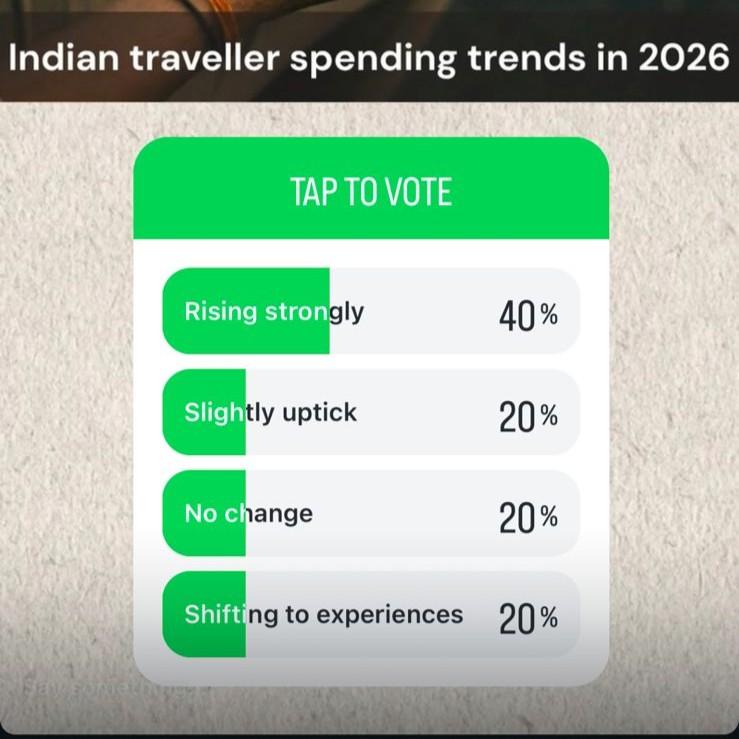
To analyse more, Travel Trends Today (T3) conducts a social media poll. Insights from poll show while 40% of respondents say travel spending is rising strongly and 20% see a slight increase, another 20% report no change, and 20% are shifting focus towards experiences over big-ticket travel.
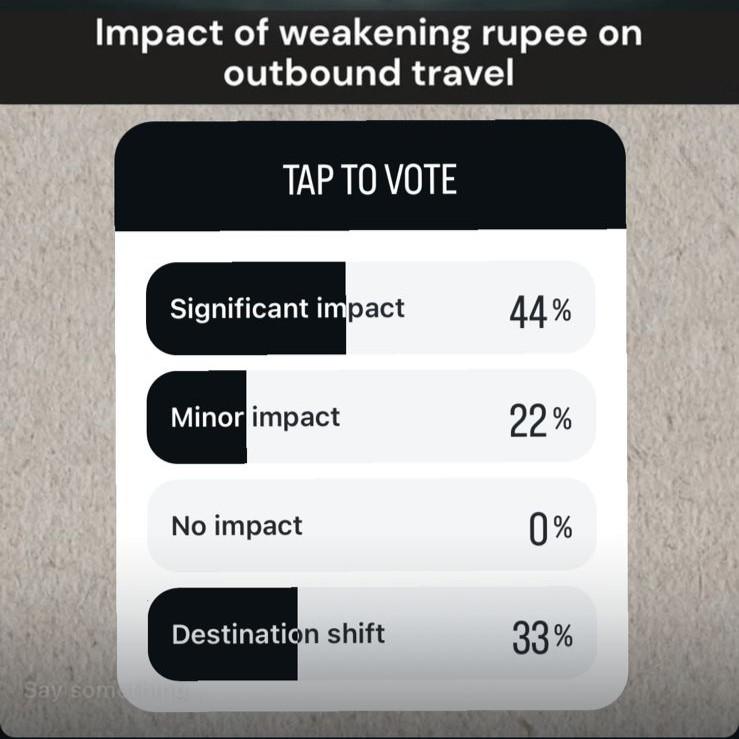
On outbound travel, the impact of the weakening INR is evident. As many as 44% say the effect is significant, 22% see a minor impact, and 33% are already changing destinations. Notably, no respondent reported zero impact, underlining how deeply currency movements are influencing travel decisions.
Impact on Outbound Travel Budgets

T3 also reached out to industry experts to assess the ground reality, including Neil Patil, Founder, COO and CTO, Veena World; Mahendra Vakharia, Managing Director, Pathfinders Holidays; and Shiv Kukreja, Director, Rove Routes Pvt Ltd.
“The weakening rupee is definitely impacting outbound travel budgets, but not necessarily reducing the intent to travel,” says Neil Patil. Instead, he points to a clear behavioural shift. Travellers are becoming more value-conscious, actively choosing destinations where the rupee stretches further, such as Southeast Asia, Japan, and parts of Eastern Europe. “We are seeing shorter trip durations, a preference for all-inclusive group tours to lock in costs, and a strong move towards advance planning,” he notes. Early bookings, he adds, are being used as a hedge against further currency depreciation and rising prices, while curated itineraries with high cost predictability are gaining traction.
Mahendra Vakharia, however, is more direct about the pressure on budgets. “It is definitely creating a negative impact as costing increases quite strongly, especially for families of four or five travelling together,” he says. In response, travellers are actively reworking their plans, adjusting trip durations, changing activities, and opting for changes in hotel options to stay within budget while mitigating the impact of currency fluctuations.
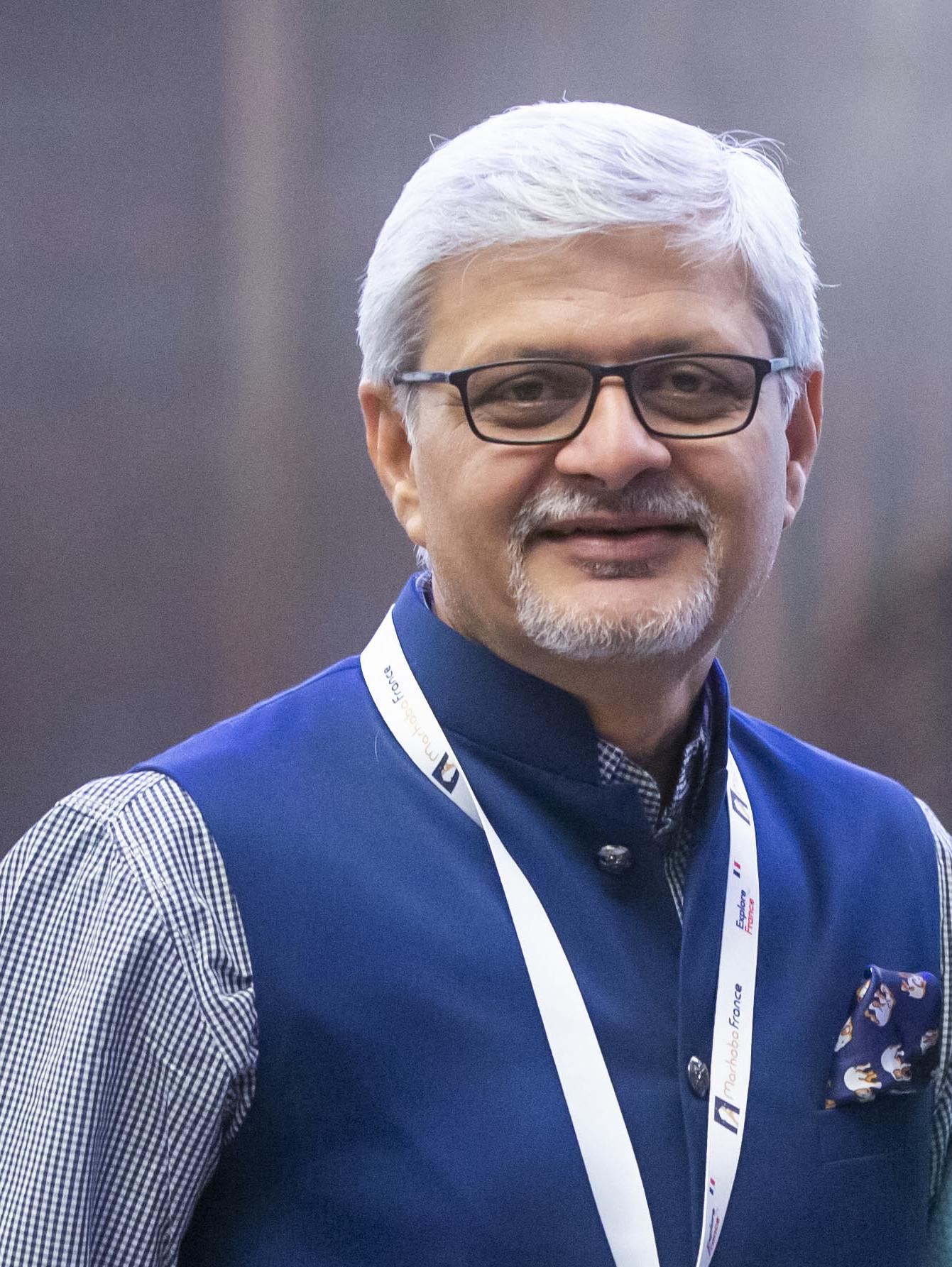
For Shiv Kukreja, the impact is both immediate and measurable. With the rupee weakening, outbound travel budgets for long-haul destinations such as Europe and the USA have risen by 8 -12%. “This is forcing many Indian travellers to rethink their plans,” he says, outlining a clear shift towards short-haul and value-driven destinations including Vietnam, Thailand, Dubai, Indonesia, and Singapore, where the rupee offers better value.
This recalibration is visible in how trips are being designed. Travellers are opting for shorter 4 - 5-night holidays instead of 7 - 10 days, choosing 3-star and 4-star properties over luxury resorts, and increasingly considering domestic alternatives to manage costs. Kukreja notes a growing interest in premium Indian destinations such as Ladakh, the Andamans, and the Northeast, which offer comparable experiences at a lower overall spend. Among Rove Routes’ clientele, even luxury and group travellers are leaning towards rupee-friendly packages and booking early to secure better deals.
Shifting Preferences in 2026
Looking ahead to 2026, the shift is expected to deepen rather than reverse. Patil believes Indian travellers will continue to prioritise experiences over pure luxury, but with a stronger focus on value, convenience, and cost assurance. “All-inclusive travel will grow significantly as customers seek transparency and control over total trip costs,” he says.
Demand for immersive experiences: spanning culture, food, and nature, is expected to rise, even as multi-country itineraries and long-haul travel continue to attract repeat travellers. At the same time, technology-enabled planning, personalised journeys, and assisted travel with expert support are becoming increasingly important in a more complex travel environment.
Vakharia highlights a contrasting sentiment, while the intent to travel remains strong, the destination mix is shifting. “Travellers are definitely keen to travel, but many are now considering alternate destinations instead of Europe and westbound itineraries,” he explains, pointing to growing interest in Asia Pacific, South Africa, and domestic travel. However, he also flags a broader economic concern, noting that uncertainty in West Asia is not only affecting travel sentiment but also impacting the businesses of many clients in manufacturing and related sectors. “It is a wait-and-watch situation for many,” he adds.

Kukreja sums it up simply: “Indians won’t stop travelling despite a weak rupee.” Instead, behaviour is evolving across segments. High-net-worth travellers are retaining luxury budgets for milestone trips, while middle-class travellers are shortening holidays (4-5 days), capping hotel spends (INR 5,000/night max) and booking earlier to secure value. There is a visible shift towards taking multiple shorter trips in a year rather than one long vacation, with a growing preference for wellness retreats, adventure travel, and family-focused experiences.
Destination choices are also being redrawn. Nearby, visa-friendly locations such as Vietnam, Thailand, Sri Lanka, Dubai, and even Russia are gaining traction, while expensive long-haul markets like Europe and the USA are increasingly being deferred unless essential. Within India, destinations such as Rajasthan, the Andamans, and the Northeast are emerging as strong alternatives, offering a similar sense of escape at a more manageable cost.
For the trade, the takeaway is clear. The Indian traveller remains resilient and deeply committed to travel, but expectations have changed. Value, flexibility, and experience now define decision-making. As Kukreja puts it: Indians will continue to travel, but they will spend smart: choosing closer destinations, shorter stays, and planning ahead to stay ahead of the rupee.