Tourism Ministry pushes city-level Convention Bureaus; pricing discipline, national framework musts
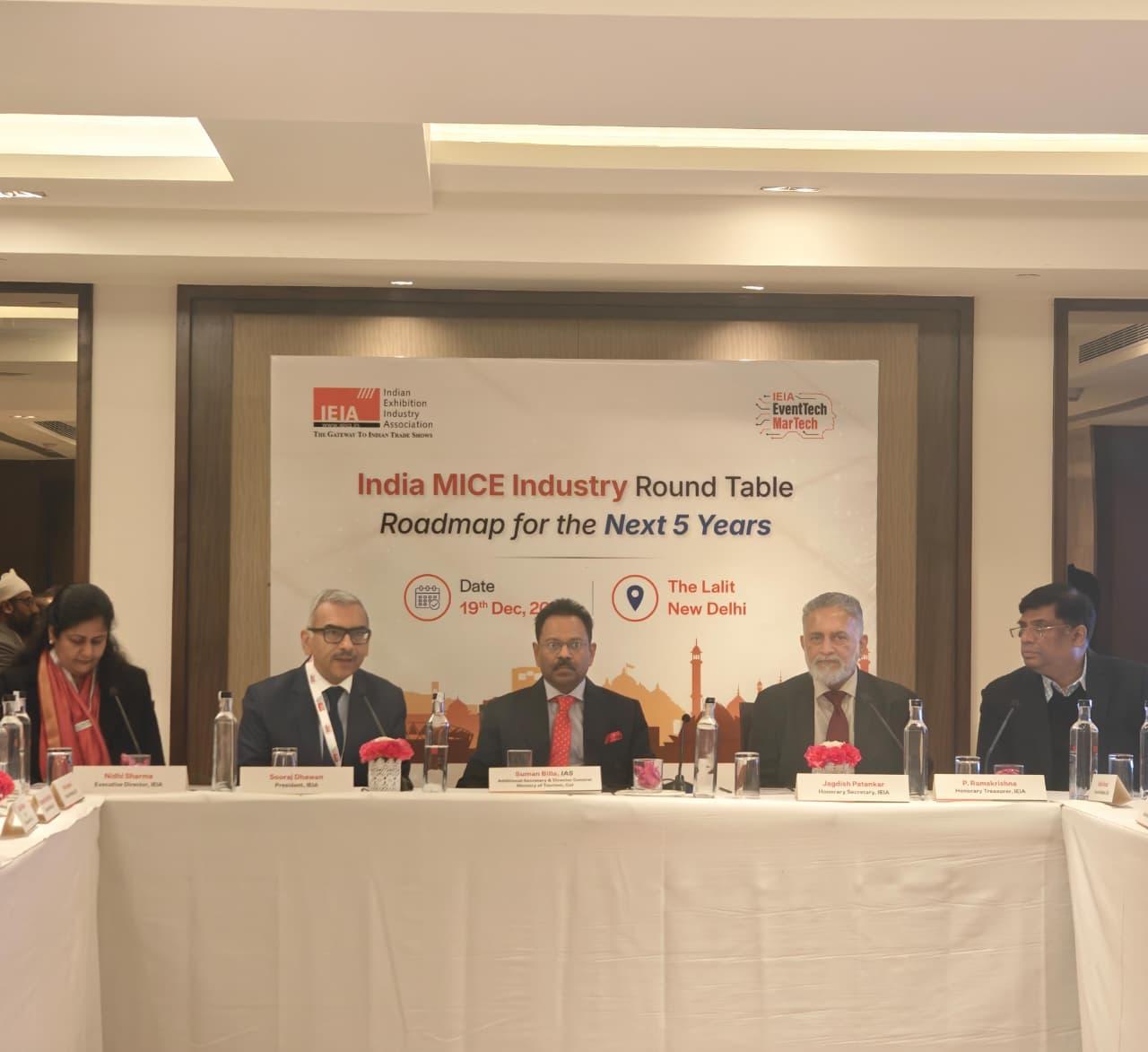
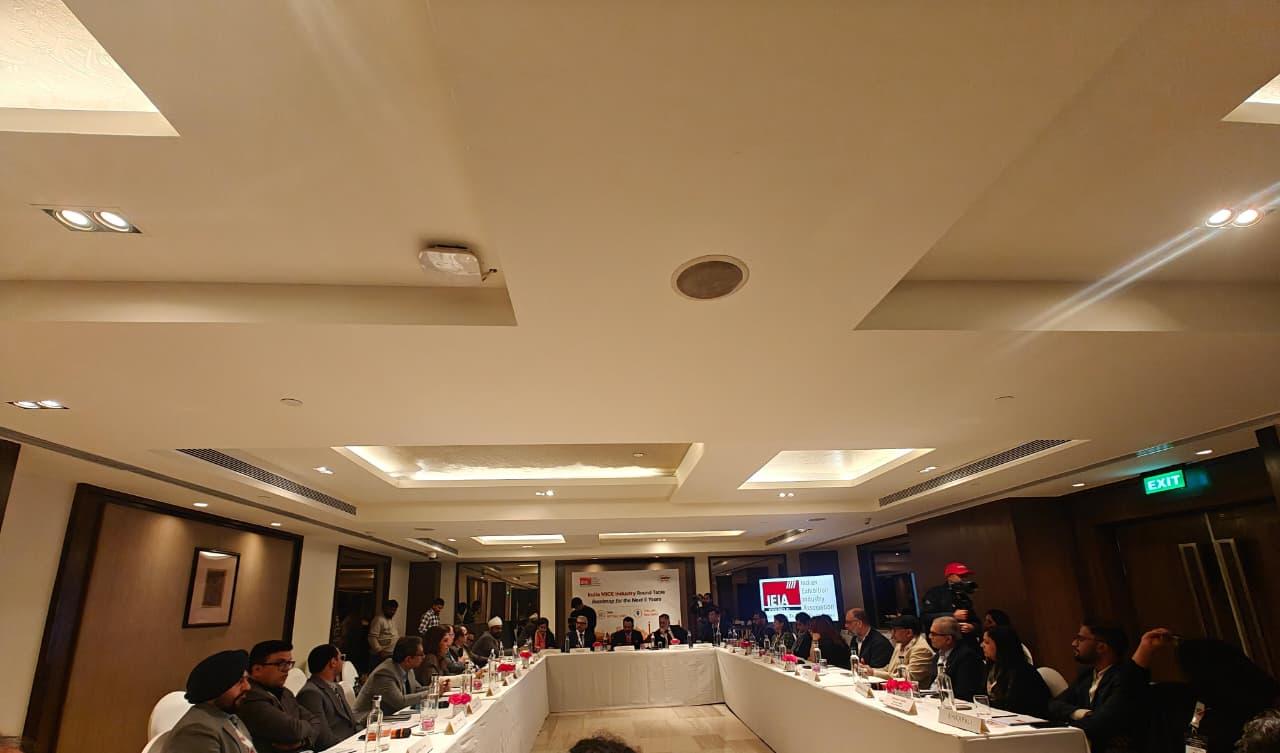
 Snapshot from IEIA Roundtable in Delhi
At an IEIA roundtable in Delhi, government and industry leaders acknowledged that uneven pricing practices and weak destination-level planning are now bigger barriers than infrastructure itself. However, drawing confidence from the successful hosting of G20 meetings, rising global interest and with government’s willingness to work along, stakeholders see the current push towards coordinated city-level strategies as a timely opportunity to elevate India’s standing as an international MICE destination. Event report below:
India’s meetings, incentives, conferences and exhibitions (MICE) sector is poised for its next phase of growth, but only if the industry moves beyond mere infrastructure creation to structured collaboration, digital adoption and city-level convergence, reiterated Suman Billa, AS & DG, Ministry of Tourism, Govt. of India. The foundation he said, starts with the creation of city-level convention bureaus in partnership with stakeholders, beginning in 2026.
Addressing the stakeholders at the Round Table Summit on the ‘Indian MICE Industry Roadmap for the Next Five Years’ hosted by IEIA, Billa underlined that while India has emerged as one of the world’s fastest-growing large economies, the country is yet to fully capitalise on the economic potential of business events. “The opportunity before us is far larger than what we have currently leveraged,” he said, calling for a more organised, scalable and globally competitive approach to MICE development.
Billa noted that India’s growth trajectory, despite global headwinds, has reinforced the need for strong “soft infrastructure” such as conferences, exhibitions and conventions to complement manufacturing and trade. “It is no longer enough to build venues. What matters is how efficiently we operate, collaborate and bundle our offerings,” he said, adding that digitalisation and productivity-led transformation would be critical as the industry scales.
A key pillar of the Ministry’s strategy is the creation of City-level MICE and Convention Promotion Bureaus, designed to bring together government, venues, hotels, destination management companies and service providers under a single umbrella. According to Billa, such bureaus would enable cities to present cohesive, price-competitive bids to international organisers, something India currently lacks in many markets.
“Today, an organiser negotiates separately with venues, hotels and suppliers. The idea is to move towards a bundled, destination-led approach, which is already standard practice in mature MICE markets globally,” he said, citing Hyderabad’s convention bureau as an early example of how coordinated bidding can work.
The Ministry plans to anchor this initiative within the next Finance Commission cycle beginning 2026, proposing financial support for bringing large international conferences to India. The model, Billa explained, will be bottom-up: initiatives will originate from industry and city-level bureaus, be endorsed by state governments, and then receive matching support from the Government of India. This initiative will act as a single facilitator for permissions and local partner networking and will aim to double India’s share of the global MICE market within the next five years, he added.
Adding to this, Sooraj Dhawan, President, Indian Exhibition Industry Association (IEIA), said that the association is working on a transformative roadmap to propel India into the top five global exhibition markets. India’s MICE market, valued at USD 49.4 billion in 2024, is projected to grow to USD 103.7 billion by 2030. Central to capturing this growth is the national strategy of establishing professional City MICE Bureaus on a Public-Private Partnership (PPP) model. These bureaus will act as a ‘single window’ for event organisers, significantly improving ease of doing business and addressing long-standing ecosystem fragmentation, as per Dhawan.
Billa further stressed that India’s MICE capability is no longer confined to a handful of metros. “We are already seeing world-class events being delivered in smaller destinations, courtesy the G20 meetings we hosted. The capability is not in question anymore. What we need is better collaboration and a unified strategy to optimise our potential,” he said.
He also noted that by integrating smart technologies into the major event venues, and accelerating digital adoption across the ecosystem, India will be well positioned as a future-ready exhibition and events destination.
The industry response
At this high-level roundtable convened by the Indian Exhibition Industry Association (IEIA), industry leaders, venue operators, international organisers and government representatives flagged that while India can now host mega global events, it risks losing future business to Southeast Asia and the Middle East unless systemic reforms are fast-tracked.
Industry participants broadly welcomed the move of bringing in city-level bureaus, highlighting that a single large convention could generate millions of revenues from hotel nights, transport movements, tourism and ancillary services. However, the sector lacks mechanisms to consistently measure and monetise this spillover impact.
Participants agreed that India’s challenge is no longer venue capacity. With facilities such as Bharat Mandapam, ITPO Pragati Maidan and India Expo Centre & Mart, Delhi NCR alone now rivals established global exhibition cities. However, MICE events in India continue to function in silos, lacking city-wide coordination.
Unlike global MICE destinations where conventions are treated as city festivals, with integrated transport, retail, hospitality and tourism support, Indian events often struggle with last-mile connectivity, inconsistent civic engagement and limited visitor facilitation.
Industry leaders stressed that MICE must be positioned as a city-led economic engine, not merely a venue-based activity.
Price-discipline important
A major concern raised was the complex permissions regime, even at purpose-built exhibition centres. Organisers flagged multiple clearances, high compliance costs and varying state-level norms as deterrents for international event owners.
Surge pricing by hotels and airlines during peak exhibition periods drew sharp criticism too. Industry representatives cited instances of hotel room rates multiplying several times during large events, making India uncompetitive for international delegates despite lower venue costs. Speakers warned that such pricing reduces delegate turnout and dilutes tourism-led economic gains.
Calls were made for greater predictability, rationalisation and transparency in pricing during large conventions.
Creating National MICE Bureau
Professional Conference Organisers (PCOs) noted that while India’s market size draws some conferences organically, many international events are lost due to the absence of a national-level support mechanism and marketing development assistance.
Besides a recurring demand for urgent creation of city-level MICE promotion bureaus, industry leaders also pressed for a national MICE bureau to act as a single-window interface for global organisers, similar to Singapore, Thailand and Hong Kong, supporting international bidding, incentives, standardisation and global outreach.
Speakers also flagged a growing human capital deficit in trained MICE professionals. The industry called for short-term, modular skill programmes aligned with live event needs, rather than long academic courses.
On standards, IEIA confirmed that India’s first comprehensive exhibition standards framework, developed with the Bureau of Indian Standards (BIS), will be released shortly and proposed for global adoption through ISO, marking a significant step towards professionalisation and consistency.
Sustainability initiatives, including zero-waste exhibitions and standardised green practices, are also being aligned with venue operators and organisers.
Government signals willingness
Responding to the industry feedback, Billa at the end acknowledged the need to move from a reactive to a proactive MICE strategy. He highlighted that the ministry plans to:
- Encourage state governments to set up MICE promotion cells
- Create shared funding models where states and industry co-invest in attracting events
- Improve coordination across ministries for approvals, visas and logistics
- Explore incentives for hotels and infrastructure development around major venues
- Support targeted skill development through hospitality and tourism institutions
He concluded saying that sustained industry engagement and clear proposals are essential to drive policy reform, noting that isolated annual discussions will not yield systemic change.
The event also witnessed the launch of IEIA’s strategic report, titled “India MICE Opportunities Overview (2025–2030)”, which outlines a comprehensive blueprint for leveraging institutional support and technology to strengthen India’s leadership in the global MICE sector.