From Hype to Habit: How AI is reshaping travel
What was once positioned as a future-facing innovation is now deeply embedded in the industry’s operating core, influencing everything from when and where people travel to how companies’ price, personalise and service journeys at scale. At SATTE 2026, this shift came into sharp focus, with industry leaders underscoring that AI is not just enhancing decision-making, it is fundamentally rewiring it, even as they also stressed that the human layer remains critical for trust and high-value travel decisions.
Artificial Intelligence is fast moving from industry buzzword to business backbone, with travel sector emerging as one of its most immediate and high-impact use cases. At a special chat titled “From Hype to Habit: How AI is reshaping global travel” at SATTE 2026, Olivier Ponti, Director of Intelligence & Marketing at Amadeus set the tone by underscoring how the convergence of booking data, traveller intent signals and predictive analytics is enabling the industry to move from reactive to anticipatory decision-making.
At a destination level, Ponti illustrated how AI-led “growth management” tools are helping address seasonality, one of tourism’s most persistent structural challenges. By analysing demand patterns and benchmarking destinations like India against competing markets such as Thailand and Vietnam, these tools can identify untapped source markets and optimal intervention windows. For instance, targeting the US market during India’s lean travel period between September and mid-October could unlock tens of thousands of additional room nights, enabling better utilisation of infrastructure and improved yield. The shift, he emphasised, is from merely accessing data to activating it, delivering the right message, to the right traveller, at the right time.
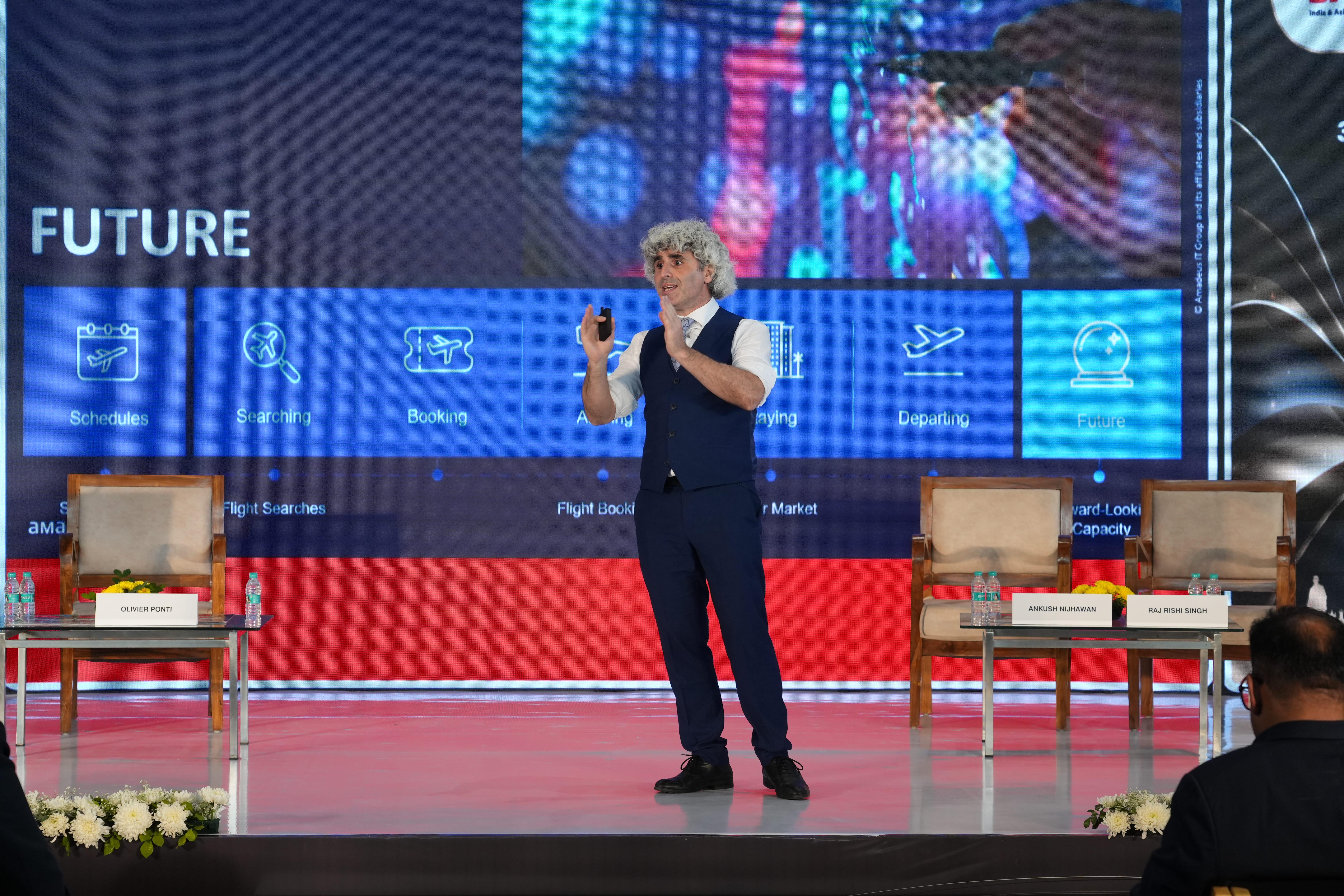
Beyond destinations, AI is also democratising data within organisations. Tools like Amadeus’ “Advisor” are shifting the industry from data access to intelligent action, allowing even non-technical teams to query complex datasets in natural language. This marks a fundamental shift where decision-making is no longer confined to analysts but embedded across departments. Looking ahead, Ponti pointed to the rise of automated, closed-loop systems, where AI not only recommends but executes decisions, from pricing adjustments to market targeting. “We are not imagining the future, we are already building it,” he said, urging stakeholders to start small but start now.
AI powering predictive travel decisions
Building on this foundation, Ponti moved on to moderating the fireside chat with Ankush Nijhawan, Co-founder, TBO.COM and Raj Rishi Singh, CMO & CBO of MakeMyTrip Limited.
Kickstarting the conversation, Singh reinforced that for leading travel platforms, AI has already moved firmly into the realm of habit. “It’s not hype, it’s a habit,” he affirmed, explaining that at the scale of millions of searches and transactions, AI-driven decision-making is no longer optional but foundational.
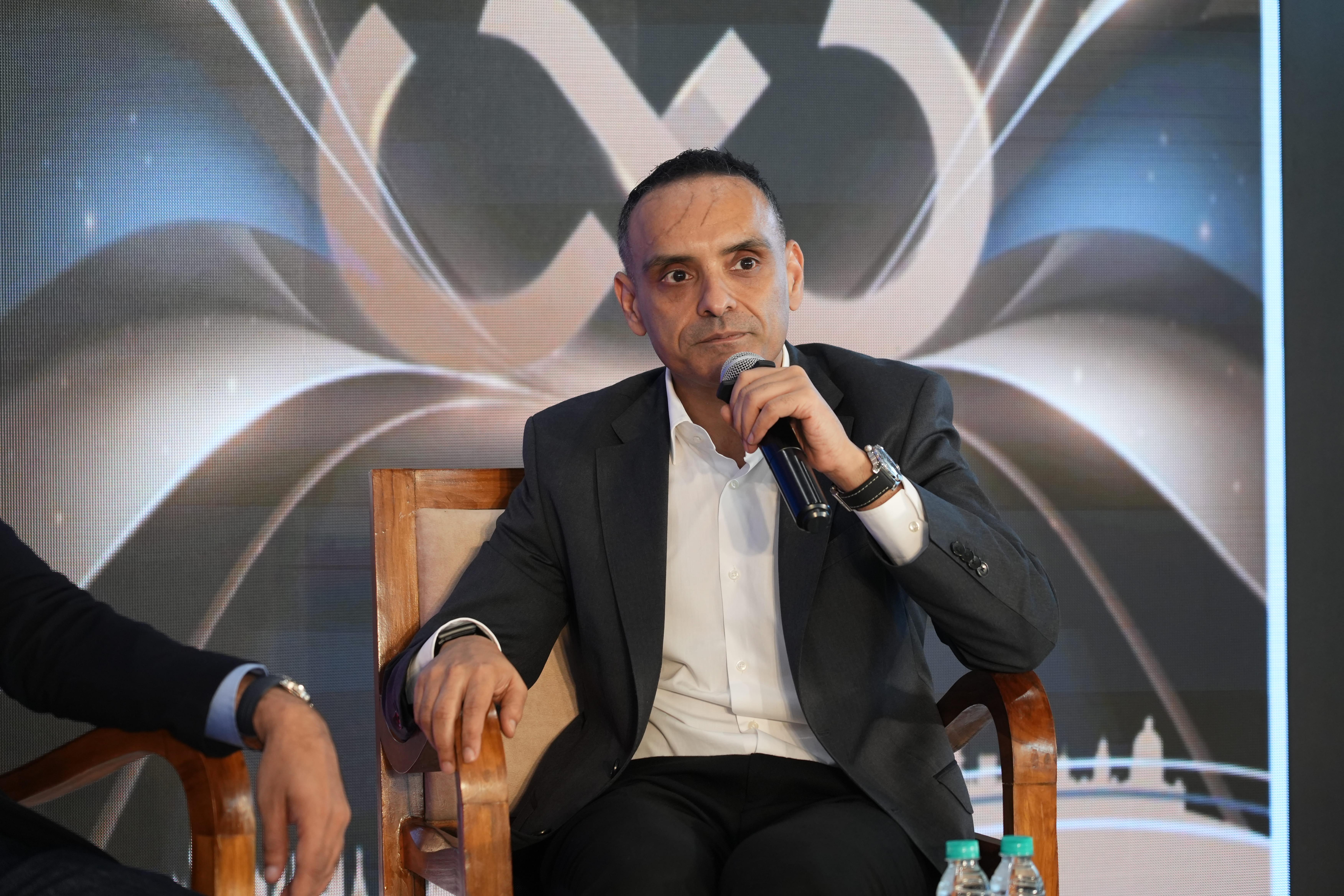
For MakeMyTrip, AI is already delivering measurable impact across three critical areas—post-booking service, personalisation, and pricing. Automation and conversational interfaces have significantly reduced the cost of servicing travellers, while hyper-personalisation engines, driven by consumer intent data, are now powering both conversion and loyalty, as shared by Singh. “Currently, we allocate 80-90% of our resources to a combination of AI and human models,” he emphasised. Meanwhile, predictive pricing models are enabling platforms to remain competitive in India’s highly fragmented, multi-channel booking ecosystem.
Crucially, Singh underscored that the real moat is not coding but building data engines that learn and evolve over time.
AI as a “teammate”
Nijhawan recalled how over the past 20 years in the business, he has witnessed the evolution of travel industry, especially since the internet emerged in the late 90s. “Back then, there were predictions that the travel industry would collapse and that traveling itself would decline. However, the reality has been quite the opposite, what we see today is an industry that grows larger and stronger every year. Our own business has achieved nearly 20% growth in recent years, alongside the rise of internet-enabled companies like MakeMyTrip.”
From a B2B lens, he sees AI as an enabler rather than a disruptor, particularly in a market as complex and fragmented as India. Nijhawan positioned AI as a “teammate” for travel agents, enhancing efficiency without replacing the human layer that remains critical for trust and complex itineraries. “It will help you grow faster, be more efficient, and reduce costs—but it cannot replace the distribution and relationships we’ve built over decades,” he said. He pointed to operational gains through AI-driven chatbots, smarter supply mapping, and data-led decision-making, while acknowledging that challenges such as fragmented supply chains and visa complexities in India still require human intervention.
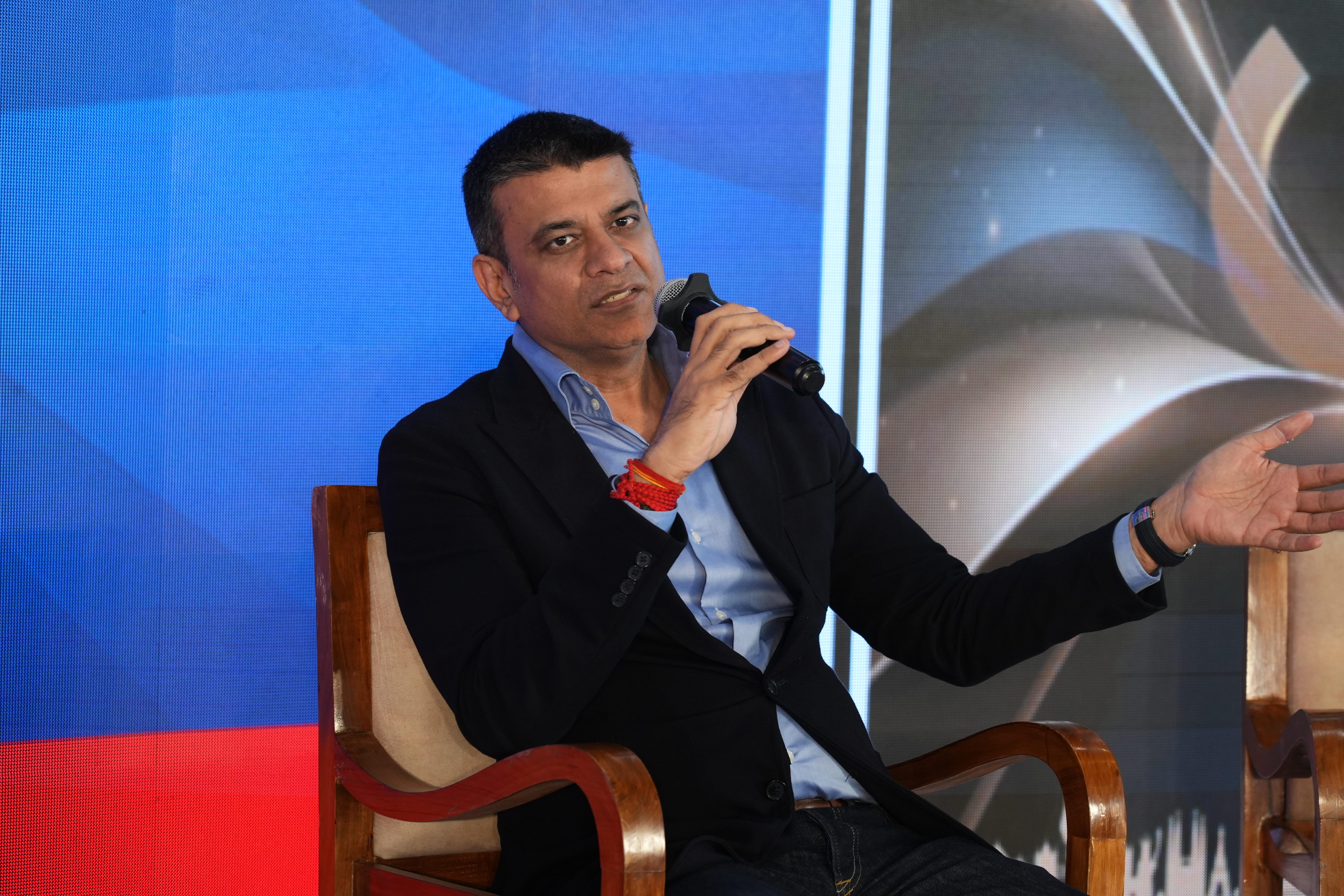
“While AI offers immense potential, especially on the front end, its adoption varies significantly. In major cities like Delhi and Mumbai, discussions around AI are relevant, but in tier-3 cities, trust remains paramount. People care less about the technology and more about ensuring that when they spend, they receive exactly what they expect,” Nijhawan said, adding that on the back end, TBO’s AI systems are designed to address these gaps, not necessarily as direct revenue drivers but as tools to enhance trust, efficiency, and long-term value.
The discussion also highlighted how AI is reshaping consumer interaction layers. Voice and conversational AI are increasingly bridging usability gaps, particularly for non-tech-savvy users.
Singh revealed that nearly “40–45% of chatbot adoption is coming from users who struggle with traditional app interfaces,” signalling a shift towards more intuitive, conversation-led booking journeys.
Yet, both panellists agreed that high-value and complex travel, such as luxury or multi-country itineraries, will continue to rely on human expertise, reinforcing a hybrid future rather than a fully automated one.
The Human Layer
As AI adoption deepens, its impact is also being felt across organisational roles. Functions such as revenue management, customer support, and coding are rapidly evolving, with machines taking over repetitive, high-frequency tasks. However, complete automation remains distant.
Singh contextualised AI adoption within India’s rapidly expanding traveller base, pointing out that the market’s diversity will continue to demand a hybrid approach. With an estimated 50 million Indians currently able to afford travel, set to grow to nearly 90 million, first-time travellers will form a significant share of future demand. “Every year, nearly 50% of visitors to destinations like Paris are first-time travellers; they need assistance,” he noted, adding that discovery, planning and execution still require varying degrees of human support. In this context, AI is not replacing existing channels but coexisting with them. “There will always be a channel of choice, OTAs, travel agents, and assisted journeys will continue alongside AI-led interfaces,” he said, reinforcing the idea of a layered, democratic travel ecosystem.
At the same time, conversational AI is already reshaping user behaviour, particularly among less tech-savvy consumers. Singh revealed that nearly 40–45% adoption of Myra chatbot is driven by users who struggle with traditional app navigation, instead opting for voice-led or conversational booking journeys, from ticketing to cancellations. However, he cautioned against overestimating full automation. While AI is increasingly handling high-frequency tasks such as customer queries and revenue management decisions at scale, human oversight remains critical. “Agentic systems may be 99% accurate, but for companies like ours, even 1% error is unacceptable,” he said, noting that complex use cases and high-stakes decisions will continue to require human intervention even as AI takes over routine workflows.
“As technology becomes more affordable and data engines evolve, our focus is on the human layer, understanding the behaviour of the hundred million users who visit MakeMyTrip. It’s about analysing their searches, inspiring them, converting them, and delivering the right communications,” Singh added.
Echoing this, Nijhawan said that while up to 70% of routine queries can be automated, the frontline sales, negotiation, and experiential travel will remain firmly human-driven.
“The challenge lies in integrating supply and client interactions through AI, which remains disjointed for now,” he admits. Addressing concerns about AI replacing people, Nijhawan’s stand is firm: “AI can't replace the demand and distribution we control, nor the brand loyalty built over decades.”
The consensus from the panel was clear: In India’s rapidly expanding travel market, where first-time travellers and assisted journeys continue to dominate, the future will not be AI versus humans, but AI working alongside them, quietly shifting from just the hype to habit.